Client → Service
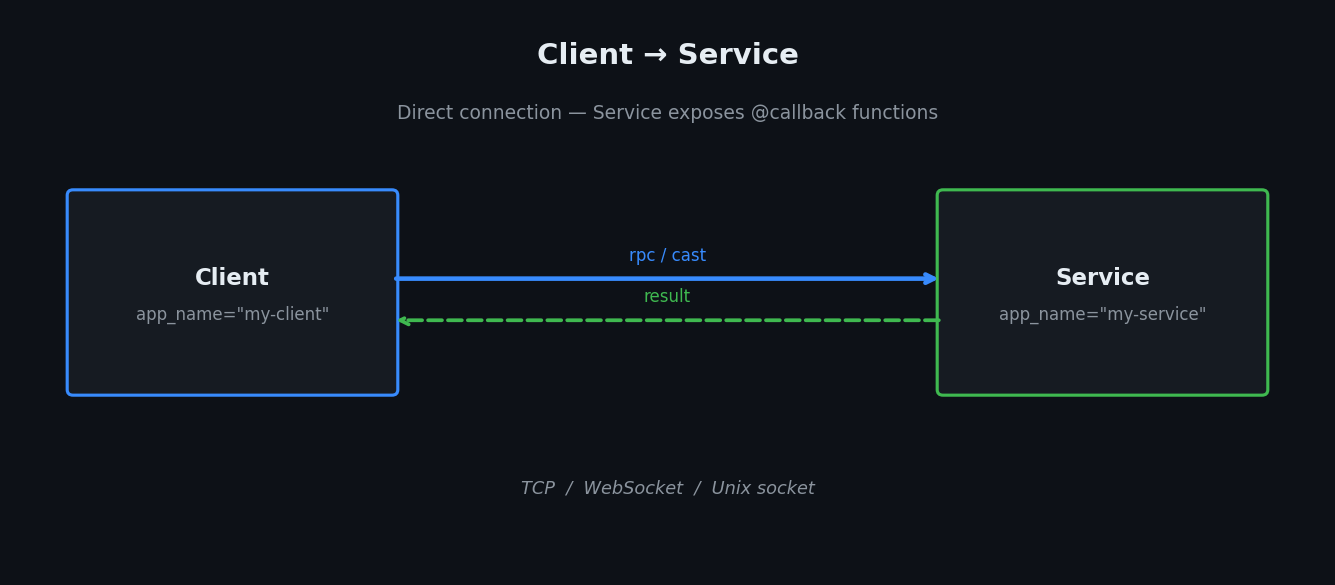
The simplest daffi topology: a Service hosts @callback functions; Clients call them.
Callbacks in the Service vs Router topology
In this topology Clients are pure callers — they connect to the Service and issue RPC calls, but do not expose their own callbacks.
If you need Clients that also expose @callback functions (workers) or peers that call
each other, use the Router topology instead. In that model every Client
can register callbacks and call other connected clients' callbacks through the Router.
Service
from daffi import Service, callback

@callback
def add(a: int, b: int) -> int:
    print(f"[service] add({a}, {b})")
    return a + b

@callback
def greet(name: str) -> str:
    return f"Hello, {name}!"

if __name__ == "__main__":
    svc = Service(
        app_name="calc-service",
        host="127.0.0.1",
        port=5001,
    )
    svc.start()
    print("Service running — press Ctrl+C to stop.")
    svc.join()   # blocks until Ctrl+C
Service parameters
| Parameter | Type | Description |
|---|---|---|
app_name |
str |
Unique name for this node. Auto-generated if omitted. |
host |
str |
TCP host to listen on. |
port |
int |
TCP port to listen on. |
unix_sock_path |
os.PathLike |
Unix socket path (mutually exclusive with host/port). |
workers |
int |
Concurrency level for callback execution. Default: 1 (inline). |
tls |
bool |
Enable TLS. Requires cert_file and key_file. |
Concurrent callback execution
By default (workers=1) callbacks are executed inline — one at a time, in the
poller thread. A slow callback blocks every subsequent call until it finishes.
Thread pool (workers=N)
Set workers=N to process up to N callbacks in parallel using a thread pool.
Good for I/O-bound callbacks — the threads release the GIL while waiting on
network, disk, or database, so they genuinely run in parallel:
import time
from daffi import Service, callback

@callback
def fetch_data(query: str) -> dict:
    time.sleep(0.3)          # I/O-bound — sleeps while waiting for a DB / API
    return {"result": query}

# workers=1 (default): 10 concurrent callers finish in ~3 s total
svc = Service(host="127.0.0.1", port=5000, workers=1)

# workers=10: 10 concurrent callers all finish in ~0.3 s
svc = Service(host="127.0.0.1", port=5000, workers=10)

svc.start()
svc.join()
The same workers parameter applies to a Client acting as a worker in the
Router topology:
from daffi import Client, callback

@callback
def process(task: str) -> str:
    time.sleep(0.5)
    return f"done: {task}"

client = Client(app_name="worker-1", host="127.0.0.1", port=6000, workers=8)
client.connect()
client.join()
Choosing the right value for workers
| Callback type | Recommended setting |
|---|---|
| Fast / pure-Python | workers=1 (default inline mode, zero overhead) |
| I/O-bound (network, disk, DB) | workers=N (thread pool) |
| CPU-bound (math, compression, ML inference) | Run multiple separate worker nodes behind a Router — Python's GIL limits true CPU parallelism within one process. |
Client
from daffi import Client

if __name__ == "__main__":
    client = Client(app_name="calc-client", host="127.0.0.1", port=5001)
    conn = client.connect()

    # Blocking call — waits for the result.
    result = conn.rpc(timeout=5).add(3, 4)
    print(f"add(3, 4) = {result}")          # → 7

    # Fire-and-forget — returns immediately.
    conn.rpc_nowait().greet("world")

    client.stop()
Client parameters
| Parameter | Type | Description |
|---|---|---|
app_name |
str |
Unique name for this node. |
host |
str |
Service host to connect to. |
port |
int |
Service port to connect to. |
unix_sock_path |
os.PathLike |
Unix socket path (alternative to host/port). |
conn.rpc()
| Option | Type | Description |
|---|---|---|
timeout |
float \| None |
Seconds to wait for a result before raising. None = wait forever. |
receiver |
str \| None |
Pin the call to a specific node by name. In the Service topology there is only one Service so this is optional. |
serde |
SerdeFormat |
Serialisation format (default: PICKLE). |
conn.rpc_nowait()
Same options as rpc() except timeout (ignored — no result is waited for).
Callbacks in a class
Instead of decorating individual methods you can apply @callback to the whole class.
daffi will instantiate the class (calling __init__ with no arguments) and register every public method as a remote callback.
Rules:
- Methods whose names start with
_are skipped automatically. - Methods decorated with
@localare excluded — they remain purely local. - All other public methods become callable by remote clients.
from daffi import Service, callback
from daffi.registry import local


@callback                          # ← decorate the class, not individual methods
class TextProcessor:
    def __init__(self):
        self._call_count = 0       # private — not exported

    def upper(self, text: str) -> str:
        self._call_count += 1
        return text.upper()

    def reverse(self, text: str) -> str:
        self._call_count += 1
        return text[::-1]

    def word_count(self, text: str) -> int:
        self._call_count += 1
        return len(text.split())

    @local
    def reset(self):
        """Not exported — only callable within this process."""
        self._call_count = 0


if __name__ == "__main__":
    svc = Service(app_name="text-service", host="127.0.0.1", port=5003)
    svc.start()
    svc.join()
The three public methods (upper, reverse, word_count) are registered as callbacks.
_call_count (private attribute) and reset (@local) are never exposed to callers.
Tip
The class must be constructable with no arguments when decorated at class level.
If you need to pass constructor arguments, initialise the object first and decorate its methods individually instead.
cast() with a Service
cast() broadcasts to all nodes that expose the method and collects their results as a dict.
When only one Service is running the dict has exactly one entry.
conn = client.connect()

# Broadcast — returns {service_name: result}
results = conn.cast(timeout=5).notify("hello")
print(results)   # {"notify-service": "ack: hello"}

# Fire-and-forget broadcast
conn.cast_nowait().notify("ping")
See Call Styles for a full comparison.
stream() / stream_nowait() — generator streaming
Both methods iterate a generator and send each yielded value as a separate message to the remote callback (once per chunk, no results returned). They differ only in backpressure:
stream()— waits for an ack from the service before sending the next chunk. Safe default.stream_nowait()— fire-and-forget per chunk. No ack, no backpressure. User controls rate.
Both default to SerdeFormat.OPAQUE (raw bytes, zero serialisation overhead).
Service — receives one chunk per invocation:
from daffi import Service, callback

@callback
def receive_chunk(data: bytes) -> None:
    print(f"[service] received {len(data)} bytes: {data!r}")

svc = Service(app_name="stream-service", host="127.0.0.1", port=5010)
svc.start(); svc.join()
Client — streams a generator:
from daffi import Client
from daffi import SerdeFormat

def data_source():
    for i in range(5):
        yield f"chunk-{i}".encode()

client = Client(app_name="stream-client", host="127.0.0.1", port=5010)
conn = client.connect()

conn.stream(serde=SerdeFormat.OPAQUE).receive_chunk(data_source())        # blocking, safe
conn.stream_nowait(serde=SerdeFormat.OPAQUE).receive_chunk(data_source())  # fire-and-forget
client.stop()
Options
| Option | Type | Default | Description |
|---|---|---|---|
receiver |
str \| None |
None |
Pin to a specific worker by name. None picks one round-robin. |
serde |
SerdeFormat |
OPAQUE |
Serialisation format for each chunk. |
timeout |
float \| None |
None |
(stream() only) Seconds to wait per chunk ack. |
Examples
| Example | Location |
|---|---|
| Basic rpc | examples/service/01_rpc/ |
| Class-based callbacks | examples/service/03_class_callbacks/ |
| Pickle serde | examples/service/04_serde_pickle/ |
| JSON serde | examples/service/05_serde_json/ |
| OPAQUE serde | examples/service/06_serde_opaque/ |
| MSGPACK serde | examples/service/07_serde_msgpack/ |
| Unix socket | examples/service/08_unix_socket/ |
| Events | examples/service/09_events/ |
| Generator streaming | examples/service/10_stream/ |